
Pocatello City Directory Runs
Pocatello has several overlapping directory shelves rather than one complete online run. The official Idaho State Historical Society holdings list, university guides, FamilySearch catalog, and National Park Service district studies document different years. Check the repository before traveling because catalog access, microfilm rules, and copying limits differ.
| Directory collection | Years located | Repository | How to consult it |
|---|---|---|---|
| Polk city and regional volumes | Selected runs, 1930-1986 | Idaho State Historical Society | Holdings list, then archive request |
| Polk local microfilm | 1901-11, 1913-25, 1927-35 | BYU-Idaho | Local microfilm access |
| Polk telephone directories | 1951-59 through 2001/02, with gaps | University of Idaho | Special Collections guide and visit |
| Polk business directories | Selected years, 1942-1983 | University of Idaho | Special Collections |
| 1982 Pocatello/Bannock volume | 1982, 1,010 pages | FamilySearch Library catalog | Search-only protected item; library or partner route |
| District-study citations | Polk years cited from 1901-1954 | Idaho historical district records | Online studies; cited directory remains separate |
The list is not proof of every year published. No official source established one final printed Pocatello city directory year. Describe only what the catalogs support: telephone holdings located through 2001/02 and city or regional holdings through 1986. A missing year may be held elsewhere.
The series also serve different purposes. A city volume may combine alphabetical residents, businesses, a buyer's guide, and classified listings. A telephone book can preserve a listed number and address but may omit unlisted people. A business directory follows commercial names and proprietors. National Register studies cite the underlying Polk volumes to document buildings and neighborhoods, yet those citations do not replace inspection of the directory page.
Marshall Library's Pocatello History Desk
Marshall Public Library reference staff use directories, local sources, and newspapers for focused questions. The desk is at 113 South Garfield Avenue, 208-232-1263 extension 106, mplref@marshallpl.org. For an obituary request, provide the full name, date of death, burial place if known, contact details, and a deadline. The library can fax up to ten pages.
Local microfilm does not circulate. The Pocatello Tribune run extends from January 12, 1895 through September 29, 1949, followed by the Idaho State Journal from October 1, 1949 to the present. Ask the desk for the correct reel and selective copies. A public library page did not confirm access to a commercial genealogy database, so check current terminal offerings rather than promising one.
The captured Marshall Library reference page shows the official local-history help route.
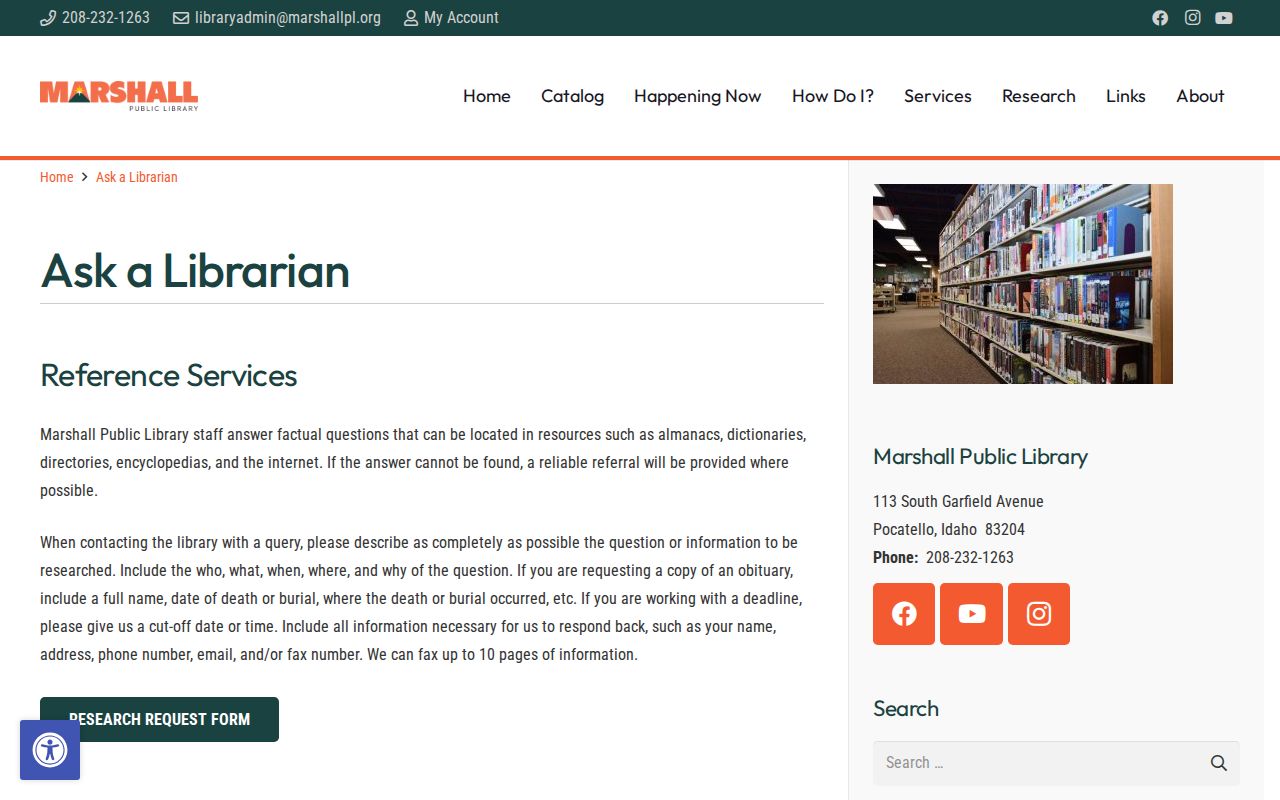
A narrow request with names, dates, and streets gives staff a far better starting point than a request to research an entire family.
Read a Pocatello Directory Entry
The protected 1982 catalog record did not expose a readable local page, so no Pocatello person's entry should be invented. The same publisher's known format indicates what to inspect: a name, relationship or widow notation, residence, trade or business, employer, and compact address abbreviations. Always use the key printed in that volume because marks can change by year.
| Indexed name | The filing name, often with initials |
|---|---|
| Relationship note | A spouse or widow notation where the volume provides one |
| Address | House number, abbreviated street, room or boarding note |
| Work or business | Trade, business, employer, or classified context where printed |
| Telephone | A listed number in telephone-era volumes, not proof of current use |
- Criss-cross directory
- An address-ordered section used to move from a street to a listed name. A distinct Pocatello run was not confirmed.
- Householder index
- An address or household-oriented list that supplements the alphabetical name section.
- Abbreviation key
- The publisher's legend for short forms such as residence, room, spouse, or street terms.
Photograph the title page, year, publisher, abbreviation key, entry, and nearby column heading. This preserves enough context to cite the result and prevents a short form from becoming an unsupported claim.
Pocatello Directories Meet Newspapers
The digitized Pocatello newspaper archive offers a second dated source. Visible metadata covered the Pocatello Tribune from 1895-1948, the Idaho State Journal from 1949-2026, the Idaho Sunday Journal from 1950-1980, and a semiweekly Tribune from 1903-1917. Digitization is ongoing, so the image and current collection list control.
Search the exact name, initials, street, business, and close spelling variants. OCR, the machine-read text behind the search, can misread narrow columns and old type. Confirm every useful hit by reading the scanned page. A newspaper may explain why a name appears at a new address, disappears, or switches from a personal listing to a business entry.
The State Archives newspaper list adds short-run titles that can close a stubborn gap, including the Idaho Herald, Pocatello Advance, Pocatello Free Press, Idaho Examiner, Idaho Labor, Pocatello Budget, Pocatello Chieftain, and Pocatello Post. Coverage varies and some runs are scattered. Search the date range suggested by the directory rather than assuming the largest newspaper carried every local notice.
Note: Newspaper text supports a directory trail, but a social notice or advertisement does not prove residence by itself.
Pocatello's 1901 Directory Puzzle
Pocatello Ordinance 89 changed street names in a precise three-day sequence: passed May 21, approved May 22, and published May 23, 1901. That local quirk can make one family seem to move between volumes even when only the printed address changed.
Test both old and current street wording. Compare the directory with a Sanborn fire-insurance sheet, which maps street numbers, footprints, and uses. Local editions cited in official district studies include 1892, 1900, 1907, 1915, 1921, 1948, and 1963 in Old Town. The May 1921 Library of Congress set contains 37 sheets.
The map is not a resident index. Its value lies in carrying a building and lot across a name change, then letting the directory add a dated person or business listing.
ISU Extends Pocatello Directory Research
Idaho State University Oboler Special Collections reports more than 360 manuscript collections focused on Pocatello, southeast Idaho, and the Intermountain West. Materials do not circulate. Visitors sign into the reading room, and staff may scan or copy case by case subject to restrictions, fees, privacy, and copyright. Contact isuarchs@isu.edu.
Useful Pocatello leads include railroad and Utah Northern papers, Kasiska family real-estate material from 1910-1970, Owens Old Town preservation work, Rowland photographs from the 1890s, Mountain View Cemetery maps in the Spanish War Veterans collection, and U.S. Land Office deeds and claims from 1892-1927. These collections add context around a directory name, not a complete roll.
The ISU Special Collections overview appears below.
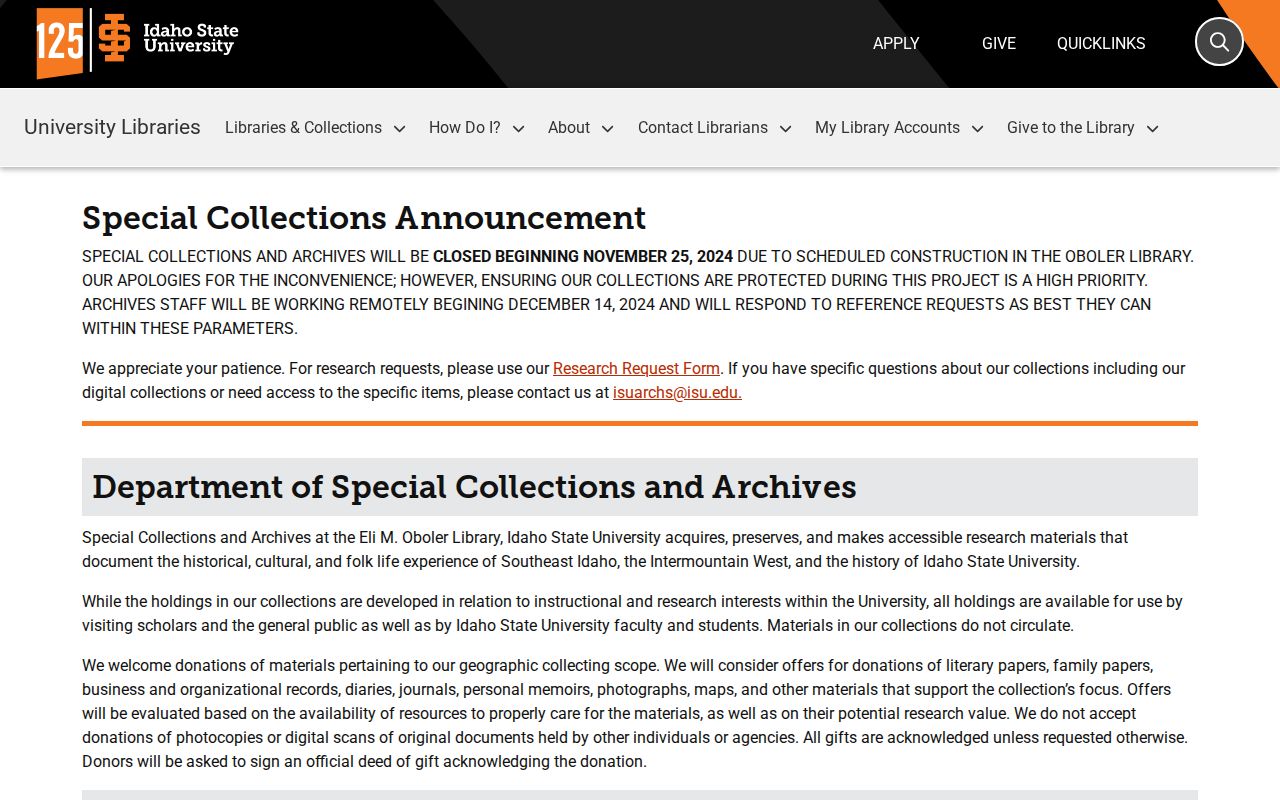
Send staff a name, date range, street, and collection lead so they can assess access and copying options.
Bannock Museum's Pocatello Collections
The Bannock County Historical Museum archive offers another local fallback when a directory or newspaper points toward photographs, organizations, or neighborhood history. The collections page asks researchers to arrange access at least two weeks ahead, complete paperwork, gain approval and a signature, and work with the collections manager. Contact bchm.collections.archives@gmail.com.
The captured museum collections page confirms that this is an arranged research visit, not an instant name database.
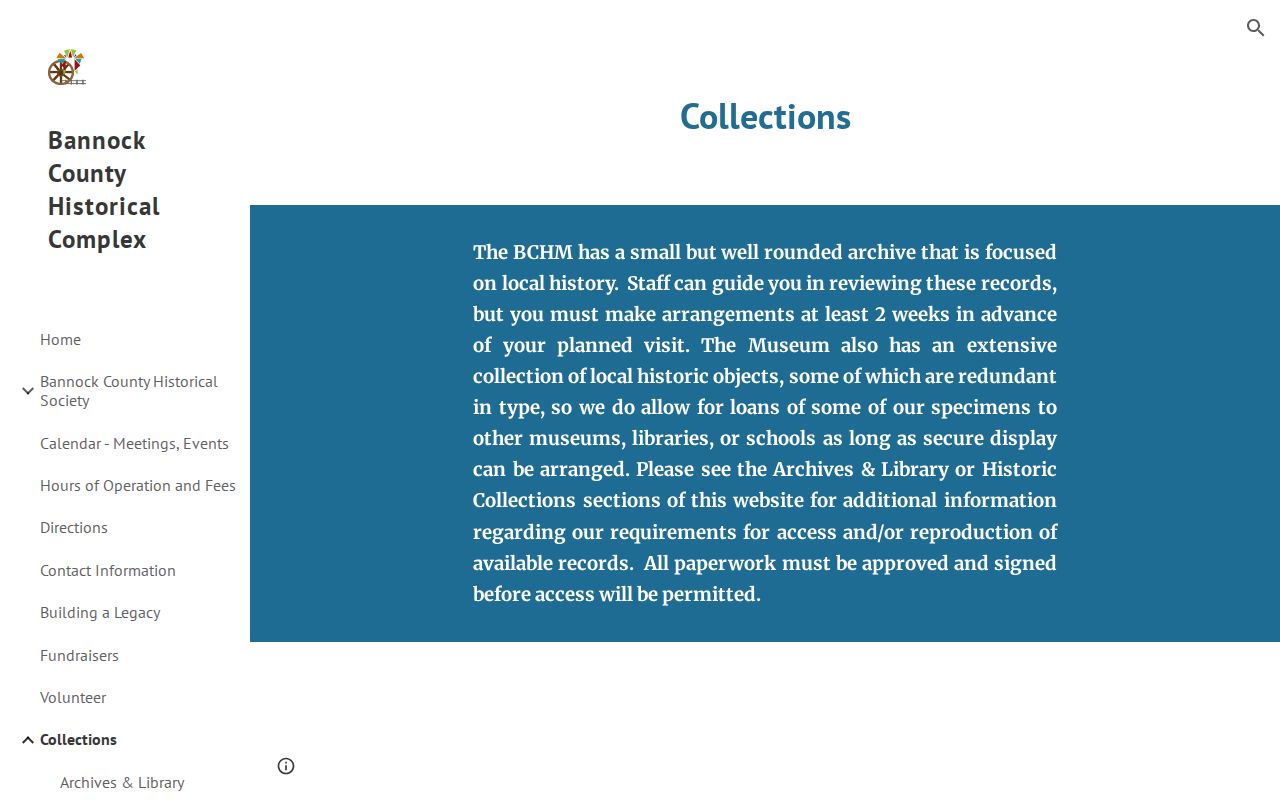
Use a city directory citation to narrow the request by neighborhood, organization, surname, or year.
Pocatello Directory Timeline
The surviving catalog trail shows how the city directory record spreads across institutions and formats.
| 1901 | Earliest located BYU-Idaho Polk run begins; the street-name ordinance also changes address wording. |
|---|---|
| 1930-31 | First clearly listed Pocatello entry in the State Historical Society holdings run. |
| 1942 | A selected Polk business-directory year appears in University of Idaho holdings. |
| 1951-59 | Early telephone-directory run documented with Pocatello and Chubbuck. |
| 1982 | FamilySearch catalogs a 1,010-page Pocatello and Bannock volume. |
| 2001/02 | Latest telephone endpoint located in the University of Idaho guide. |
These are holdings markers, not claims that publication began or ended on those dates. National Park Service studies cite Polk material as early as 1901 and through 1954 for historic neighborhoods, confirming that locally useful years can surface outside the main directory lists.
Pocatello's broader records timeline helps explain the split shelf. Bannock County was established in 1893, while railroad growth and the Academy of Idaho shaped the city's early address record. County books, municipal archives, directories, maps, newspapers, and university collections each preserved a different layer. Cite the repository, volume year, and page rather than describing a directory hit as a current public record.
Trace Families in Pocatello Directories
Family history works best as a sequence, not a single hit. A city directory entry can fill the long gap between federal census dates, while a census can show the household on one official enumeration day. The 1890 federal manuscript census was mostly destroyed, making directories, newspapers, maps, and local collections more important for that period.
- Find the first likely name in an alphabetical Pocatello city directory and record the exact spelling, initials, address, trade, and page.
- Check the year before and after. Note a move, relationship notation, business change, or disappearance without guessing what it means.
- Search the address section only if that volume has one. A separate Pocatello criss-cross series was not confirmed.
- Pair directory years with released census schedules, Sanborn maps, deeds, and newspapers. Keep owner and occupant evidence distinct.
- Close a trail with an obituary, probate file, cemetery deed or archival collection when the dated record supports it.
Disappearance can mean death, relocation, omission, a changed surname, or an unlisted number. Marshall's obituary method, ISU research services, and the 1895-to-present local newspaper holdings provide tested fallback routes. For modern address-keyed property work, use the Pocatello street directory workflow rather than stretching a historical volume beyond its date.